
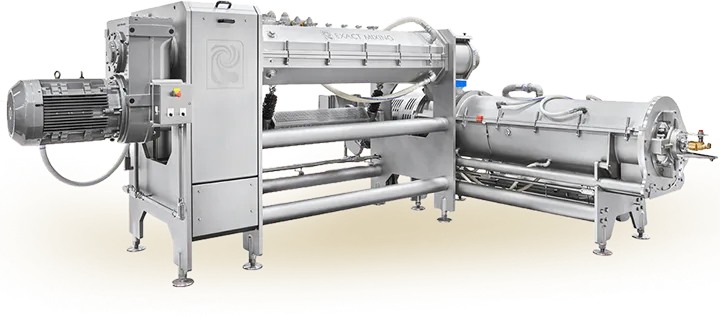
 When you’re buying commercial bakery mixing equipment in Indonesia, it’s tempting to size the system around today’s volume and call it done. At Reading Bakery Systems, we don’t think that’s enough. A mixer that fits your current production but can’t support new products, longer runs, or tighter consistency targets can become a bottleneck faster than expected. Future capacity planning isn’t just about buying something bigger. It’s about choosing a system that can support where your operation is likely to go next. We offer continuous mixing systems with capacities up to 10,000 kg per hour, which makes it possible to match equipment to current demand without boxing yourself into a short-term decision.
Why You Shouldn’t Assume Every Growth Plan Looks the Same
Not every bakery grows in the same direction, and your mixer should reflect that. Some operations expect volume increases on a single bread or bun line. Others expect a broader product mix, more changeovers, or added SKUs that put different demands on dough development. We think that’s one of the most overlooked parts of planning for future capacity.
The right answer isn’t always one larger mixer. Sometimes it’s choosing the mixer style that fits the kind of doughs you expect to make later. Our HDX Continuous Mixer is designed for highly developed doughs used in breads, buns, rolls, English muffins, and similar products, while other Exact Mixing products are built for different product families and mixing needs. That range is important because capacity planning should include product direction, not just output targets.
Why We Think Throughput Has to Match the Whole Line
A bigger mixer won’t solve much if the rest of the line can’t keep up. One of the smartest ways to plan for future capacity is to look beyond mixing and ask how dough delivery will interact with handling, forming, proofing, baking, and downstream packaging.
We design complete continuous mixing systems that include the mixer, blender, materials handling, ingredient metering, and control system because mixing capacity works best when it’s tied to the pace of the full process. If your mixer can produce more dough than the rest of the line can absorb, you haven’t really created useful capacity. You’ve just moved the pressure point. We’d rather help customers build capacity that stays balanced across the system than oversize one section and hope the rest catches up.
Why Control and Consistency Should Be Part of the Capacity Conversation
Future capacity isn’t only about how much dough you can produce. It’s also about whether you can produce it consistently at scale. As output rises, small ingredient errors and dough variation become more expensive. That’s one reason our Exact Mixing continuous mixing systems focus on precise ingredient metering, recipe control, and repeatability.
Reading Bakery Systems continuous mixing technology can improve uniformity, promote even hydration, and reduce batch-to-batch variation. We think that’s a major part of planning ahead. A system that supports stable dough quality as volume climbs is far more valuable than one that simply pushes more material through the mixer.
If you would like to learn more about our commercial bakery mixing equipment in Indonesia, we invite you to get in touch with Reading Bakery Systems whenever you like. You can do so by contacting us online or calling +1 610-693-5816.