

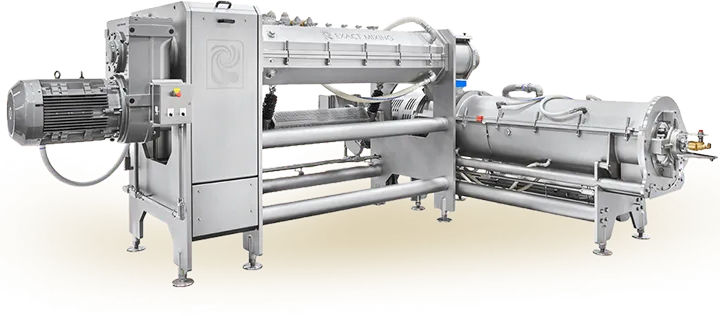
 Higher throughput can change how you judge equipment. At smaller volumes, you can sometimes tolerate extra labor, extra handling, and the occasional timing slip because the losses feel contained. Once you’re producing at a serious scale, those same issues start showing up as real dollars, real waste, and real production risk. That’s why continuous mixing equipment for industrial bakeries in Saudi Arabia often looks even more cost-effective as capacity climbs. With our Exact Mixing systems at Reading Bakery Systems, we’re helping bakeries turn high throughput from a stress test into an advantage by keeping costs from rising in lockstep with output.
Not Just a Bigger Mixer, But a Different Cost Curve
When a bakery doubles capacity with batch mixing, the investment usually rises close to twice as much because you’re adding more mixing power and more downstream support to handle the larger discharge volumes. Continuous mixing behaves differently because the ingredient metering portion of the system cost stays relatively constant even as throughput increases. In other words, you’re not rebuilding the whole front end every time you scale up. That shift in cost behavior is one of the main reasons higher-capacity continuous mixers have become so attractive, even to teams that used to feel cautious about the upfront investment.
Cutting Labor Costs Without Cutting Oversight
Higher throughput usually means higher labor pressure in the mixing area. With batch systems, larger volumes create more manual steps, more staging, and more urgency to keep dough on time, and that often requires more people per shift.
Continuous mixing can change that because the system is fully automated. Ingredient addition and mixing are handled by the recipe control system, so one operator can oversee the process, do periodic dough checks, and respond to alarms if they appear. At high capacities, alarms can actually become less frequent because the system is designed to correct many issues automatically before they become operator problems. That’s a real cost advantage when labor is tight and every added headcount has ripple effects.
Why Dough Handling Costs Don’t Have to Grow With Throughput
Post-mixing handling is one of the quiet places where batch systems get expensive at scale. Batch discharge produces a large mass of dough that typically has to be resized for downstream equipment, which adds handling machinery, space, and time.
On the other hand, continuous mixing usually outputs dough as a rope or log, and it can be cut into smaller chunks that are easier to convey and stage. Those smaller chunks can also make it easier to feed multiple lines from one mixer without turning dough distribution into a daily battle. When handling stays simpler, you’re not paying a “throughput tax” in conveyors, cutters, and extra touches.
We Support High Throughput With the Right Tools
High-capacity projects work best when equipment and visibility scale together. We build Exact Mixing systems like our HDX and MX continuous mixers to support serious throughput, and we pair that capability with RBSConnect controls so you can monitor key performance indicators, alarm history, trending, and preventive maintenance signals.
Promoting Cost Effectiveness as You Grow
Continuous mixing equipment for industrial bakeries in Saudi Arabia can look more cost-effective at higher throughput because the system scales differently than batch mixing. If you’re planning for bigger volumes, we’re ready to help you evaluate an approach that fits your products, your staffing reality, and your long-term capacity goals. Please call Reading Bakery Systems at +1 610-693-5816 or contact us online for more information.