

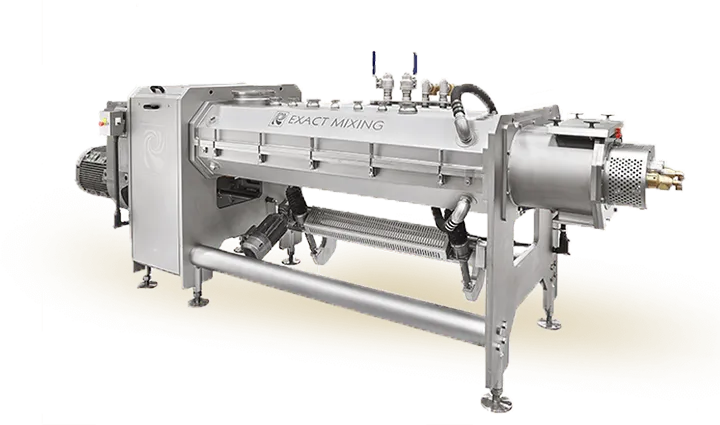
 The experts with Reading Bakery Systems will be happy to show you how continuous mixing improves dough integration and consistency. Instead of treating dough as a series of separate events, it creates a steady stream of product at the same rate the line uses it, which helps bakeries hold a more stable process through the day. That’s a big reason we see continuous mixing as a practical tool for improving dough integration rather than just a faster way to mix.
Keeping Ingredients Moving in a More Controlled Way
One of the clearest advantages of continuous mixing is the way ingredients enter the process. Our Exact Mixing continuous mixing systems meter ingredients directly into the mixing chamber instead of loading them in batches, and that gives the system more control over how dough comes together.
Mixing can be done in stages so ingredients are incorporated properly, which matters because flour, water, fats, and minor ingredients don’t all behave the same way. When ingredient addition is controlled more precisely, dough integration becomes more even and less dependent on operator timing or manual correction.
It’s Not Just the Mixer That Protects Consistency
Dough consistency doesn’t start and end inside the mixer barrel. It depends heavily on how ingredients are metered and delivered before they ever begin mixing. Our equipment uses advanced technology for precise dry ingredient feeding, with controls that monitor and manage the process. That’s important because better dough integration usually comes from fewer feeding errors, steadier ingredient flow, and more accurate liquid and dry delivery. If those upstream steps are inconsistent, the dough has to absorb that instability later.
Matching Mixer Design to the Dough’s Real Needs
Not every dough integrates the same way, so consistency improves most when the mixer actually fits the product. That’s why we offer different Exact mixer platforms for different dough conditions. Here’s a quick look at each.
- The HDX Continuous Mixer is designed for highly developed doughs at low temperatures and uses a two-stage approach, with a twin screw first stage followed by kneading in a second section.
- The EX Mixer is designed for wheat-based products and gently mixes and develops dough without generating excessive heat.
- Our LDX Mixer handles applications that benefit from separate creme up and final mixing stages.
- The MX Mixer is our most versatile option for a broad range of products and can also serve as a first-stage mixer.
- The FX Mixer is designed for potato flakes and other types of hydroscopic powders used in low-moisture mixtures such as potato chips.
That range helps us improve dough integration by using the right mixing action instead of forcing every product through one method.
Using Automation to Catch Problems Earlier
Another reason continuous mixing improves consistency is that it makes the process more measurable. Reading Bakery Systems automated systems monitor and initiate metering and mixing procedures through the control system. We build our fully automated continuous mixing equipment around sequenced, measurable, and controllable steps. That gives bakeries a better chance to confirm dough quality at the beginning of production instead of discovering variation later when time, ingredients, and product have already been lost. We like that approach because dough consistency is much easier to protect when the system is built to see problems early.
For more information on how continuous mixing improves dough integration and consistency, use our online form or call Reading Bakery Systems at 610-693-5816.