

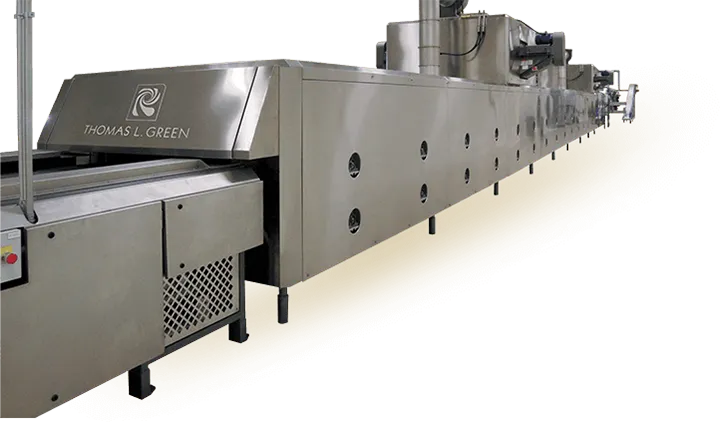
 It’s a question more commonly asked than you might realize. “Is a direct gas-fired oven better than indirect heating for baking crackers?” Over the years, the bigger differences usually show up in energy use, maintenance hours, cleaning demands, process control and how much operator attention the oven needs to stay on target. We think that’s the better way to evaluate the choice. Reading Bakery Systems Emithermic XE Oven is a long-term replacement for traditional DGF cracker ovens. The reason is that the operating impact stretches across decades, not just a few early runs.
Why You’ll Want to Look Closely at Daily Energy and Emissions Costs
One of the most important long term tradeoffs is how the oven uses energy every day. Traditional DGF ovens have been widely used for cracker baking, but those ovens can be costly to run. Our Emithermic XE design replaces ribbon burners with electric radiant heat elements, Thermatec panels and convective heat, with the goal of lowering energy consumption and emissions while still delivering the high radiant component crackers need for flavor and texture. Over a long operating life, that kind of change is significant, because small efficiency gains don’t stay small when the oven is running shift after shift, year after year.
Maintenance Isn’t Just a Service Department Issue
Maintenance is another place where the long term tradeoffs get real very quickly. A DGF oven can involve a large number of ribbon burners across the oven length, and those burners need tuning, cleaning, and replacement over time. That doesn’t just affect maintenance budgets. It affects production schedules, downtime exposure, and how often operators have to work around oven related interruptions. Reading Bakery Systems says the Emithermic XE eliminates those ribbon burners and uses easily replaceable electric burner components instead, which simplifies cleaning and maintenance and can reduce costly downtime. We think that’s one of the clearest operating differences to evaluate because an oven that asks less of the maintenance team usually asks less of the whole plant.
Why Operator Load Deserves More Attention Than it Usually Gets
Another tradeoff many teams underrate is operator load. Some oven designs demand more hands on adjustment just to hold a stable process. Traditional DGF ovens can require skilled operators to manage and adjust many burners to deliver consistent heat. By contrast, the Emithermic XE is designed around more centralized heat delivery and can be paired with our RBSConnect platform for recipe-driven controls and real-time monitoring.
Flexibility and Process Control Aren’t the Same Thing
It’s also worth comparing how each oven supports future production needs. Long term value isn’t only about lower costs. It’s about whether the oven gives you better control as products, targets, and operating priorities change. The Emithermic XE offers humidity controlled zones and optional gas or electric penthouses, along with more balanced heat across the band. That suggests a different kind of long term tradeoff. A traditional DGF oven may feel familiar, but an indirect heated design may give the bakery more usable control over moisture, texture, and consistency as product demands evolve.
Is a direct gas-fired oven better than indirect heating for baking crackers? Hopefully, we’ve provided the answer. You can ask that or any other questions by calling Reading Bakery Systems at 610-693-5816 or contacting us online.