
 Stackable potato chips production isn’t just about making the same shape again and again. It’s about keeping up with shifting demand, handling product changes without unnecessary disruption, and building a line that gives manufacturers room to adapt. That’s where process flexibility starts to matter. At Reading Bakery Systems, we design our Stackable Chip System to handle all aspects of the manufacturing process, and that gives producers a more connected way to think about output, consistency, and future opportunities.
How We’re Helping Producers Stay Ready for Change
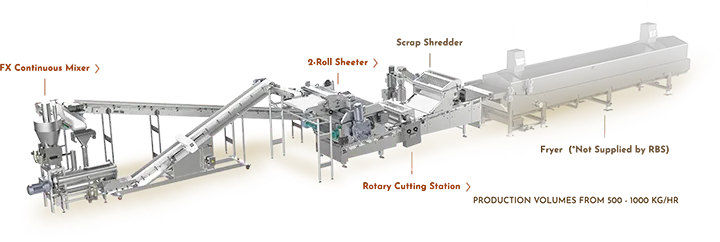
Our system includes a 2-Roll Sheeter, a specialized FX Continuous Mixing System, and a Rotary Cutting Station, all built as part of a modular approach to fabricated stackable fried chips. This approach promotes process flexibility so a production line doesn’t become a limitation the moment the business changes.
In stackable potato chips production, that can matter when demand rises, schedules tighten, or a manufacturer wants a smoother way to manage the process from mixing through forming. Our products fabricate chips reliably and efficiently, which gives bakeries a more practical foundation for handling real-world changes without rebuilding the entire line strategy. That flexibility isn’t just convenient. It can make planning and growth feel much more manageable.
Why Mixing Flexibility Sets the Tone
A lot of production flexibility begins at the front of the line. If mixing is inconsistent or difficult to control, the rest of the process gets harder to manage. That’s why our FX Continuous Mixing System matters so much in a stackable chips application. It supports a steady flow into the next stages of production and helps create a process that feels more controlled throughout the day. We don’t look at mixing as an isolated step. We treat it as a core part of how flexible production becomes possible.
One of the biggest advantages of a modular system is that it gives producers more room to align equipment with their own production goals. That matters in stackable potato chips because every manufacturer is trying to balance quality, throughput, floor space, and operational simplicity. Our system can produce between 500 and 1,000 kilograms per hour, depending on fryer capacity, showing that the equipment family supports different production contexts across our materials. The bigger point is that our system approach gives producers options instead of forcing a one-size-fits-all production model.
Why Flexibility Also Means Better Product Development
Process flexibility isn’t only about the equipment on the floor. It also means having a place to test ideas before they become production problems. We help clients develop and refine snack products, processes, and technologies through our Science and Innovation Center. For stackable potato chips manufacturers, that kind of support matters because flexibility becomes much more valuable when it’s backed by testing, collaboration, and practical process development. We’re helping customers think ahead, not just run what they already have.
Flexibility as a Growth Tool
For stackable potato chips production, process flexibility really means having more ways to respond, improve, and grow. It means the mixing and processing equipment can support today’s production needs without boxing a manufacturer into yesterday’s limits. At Reading Bakery Systems, we build that flexibility into the way our stackable chip systems are designed, and we support it with broader innovation and process collaboration. When producers have equipment that’s modular, reliable, and built around the full process, they’re in a much better position to make smart moves as the market changes. Use our online form or call 610-693-5816 to learn more.