

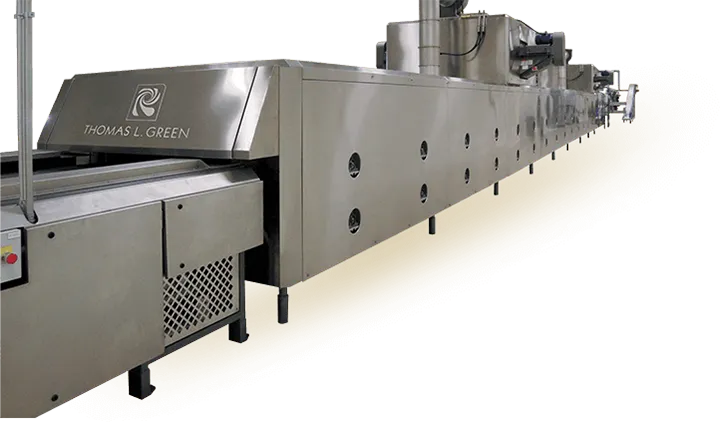
Industrial bakeries can’t afford to accept unnecessary differences in color, moisture, texture, or baking time. Yet traditional oven designs may make those variables difficult to control, especially when combustion conditions directly influence the baking chamber. Industrial oven technology replacing direct gas-fired ovens in industrial bakeries from Reading Bakery Systems is giving manufacturers another way to improve repeatability, flexibility, and control.
Why Direct Firing Isn’t Always the Best Fit
Direct gas-fired ovens release combustion products into the baking chamber. These systems have served bakeries for many years, but they aren’t necessarily ideal for every product, facility, or production strategy.
Changes in burner performance, airflow, belt loading and operating conditions can influence how heat reaches the product. A setting shown on the control panel doesn’t always reveal what individual pieces experience as they move through the oven. Manufacturers producing thin crackers, delicate crisps, bars or products with narrow moisture specifications may need more precise control.
Indirect convection systems separate combustion from the baking atmosphere. Heat is transferred through a heat exchanger and circulated through the oven, allowing processors to manage baking conditions without exposing products directly to burner gases.
Advanced Technology Doesn’t Depend on Radiant Heat Alone
Our Thomas L. Green PRISM OVEN delivers flexible, consistent baking of products such as crackers, biscuits, cookies and other baked snacks. Our Thomas L. Green Emithermic XE Oven also provides a flexible platform for baked goods while reducing energy consumption.
These ovens can be configured with multiple zones so manufacturers can establish different baking conditions as products travel through the system. One zone may support initial structure development, while later zones can remove moisture, build color, or create the required crispness. Processors aren’t limited to one uniform environment from entrance to exit.
Better Control Doesn’t Mean a Single Temperature Setting
Oven performance involves more than air temperature. Air velocity, humidity, energy transfer, exhaust, belt speed, product loading and zone balance can all influence results.
Our process specialists can use collected data to help bakeries evaluate recipes and oven settings. Manufacturers won’t have to rely entirely on trial and error when identifying why a product is too dark, too soft, too dry, or inconsistent across the belt.
Modern Ovens Can’t Ignore Energy Use
Energy expenses have a direct effect on production costs, and inefficient baking conditions may waste fuel while still producing inconsistent results. Modern oven design can help manufacturers use heat more effectively through controlled circulation, insulation, exhaust management, and recipe-based operation.
Indirect convection may also provide greater fuel flexibility depending on the oven configuration and local energy infrastructure. That can matter to processors planning new facilities or preparing for changes in energy availability.
The best efficiency gains don’t come from the oven alone. Mixing consistency, dough temperature, product thickness, loading patterns, and baking conditions must work together. We evaluate these connected variables when developing a production system.
Replacement Projects Don’t Have to Follow Old Assumptions
Replacing an established oven is a significant decision. Manufacturers need to consider line speed, product range, available space, utility connections, exhaust requirements, controls, and integration with existing upstream and downstream equipment.
We can evaluate those requirements and configure an oven around the actual operation. Customers may also test recipes and equipment at our Science and Innovation Center. Testing provides practical information about product behavior before a manufacturer finalizes a larger investment.
Industrial oven technology replacing direct gas-fired ovens in industrial bakeries can create opportunities for greater control, cleaner baking conditions and more consistent products. Reading Bakery Systems will help processors determine which of our systems offers the right path forward. Find out more by contacting us online or calling 610-693-5816.